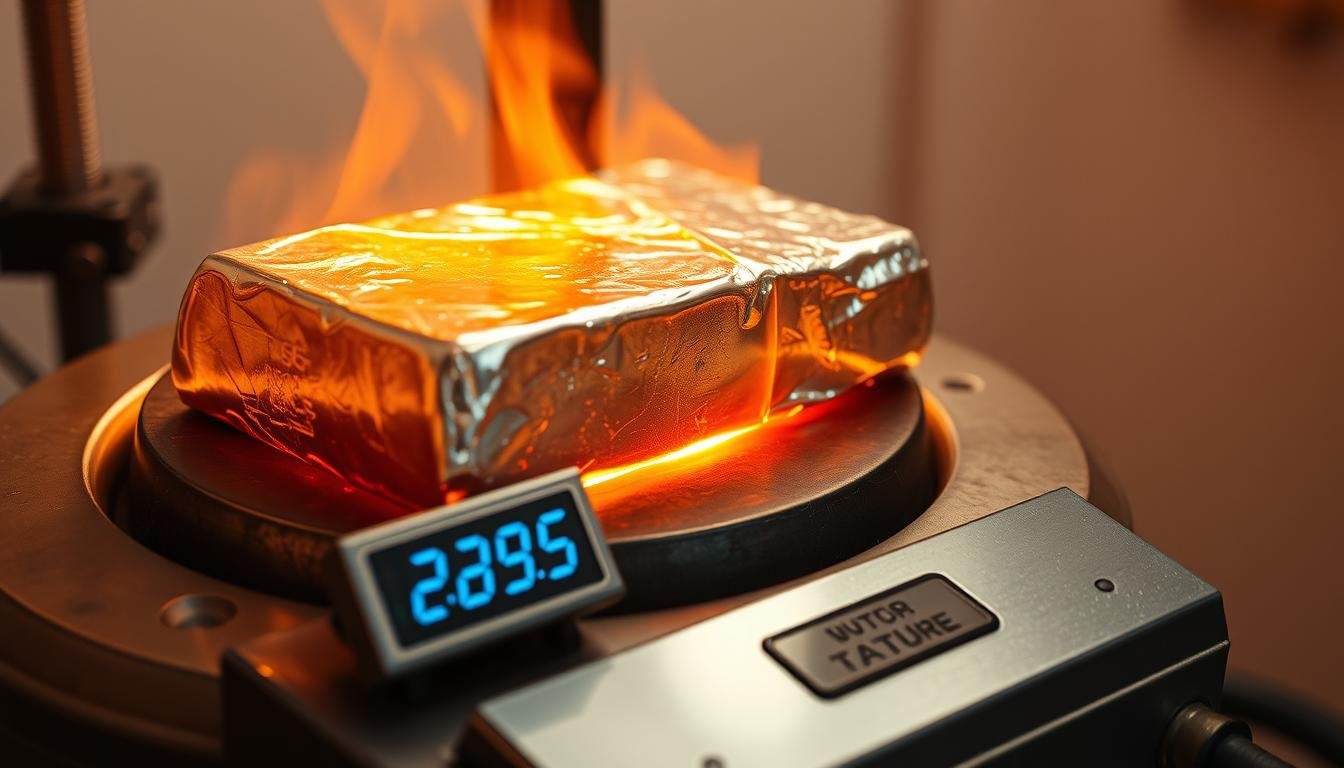
Among precious metals, few match the unique characteristics of platinum. This rare element stands out for its ability to withstand extreme heat, with a thermal stability that begins to falter only at 1,772°C. Such resilience makes it indispensable in environments where lesser materials fail.
What gives this metal its remarkable heat tolerance? The answer lies in its atomic structure. With an atomic mass of 195.09 and ranking among the densest elements, platinum’s tightly packed atoms resist separation even under intense temperature stress. This explains why it retains strength in high-energy industrial settings.
From automotive catalysts to medical implants, industries rely on platinum’s durability. Its capacity to endure 3,800°C boiling points ensures reliability in chemical processing equipment and aerospace components. Even everyday electronics benefit from its stable conductivity under thermal strain.
Beyond technical specs, platinum’s scarcity amplifies its value. Thirty times rarer than gold, its practical applications justify the premium. As we explore its role across sectors, one truth emerges: this metal’s thermal prowess reshapes modern manufacturing.
Fundamental Properties of Platinum
Scientists and engineers value this rare element for its unmatched combination of strength and stability. Its atomic structure – featuring tightly packed electrons and six natural isotopes – creates a foundation for industrial reliability. Let’s explore what makes this material outperform alternatives like silver in extreme conditions.
Chemical and Physical Characteristics
The metal’s 2.2 Pauling-scale electronegativity enables unique catalytic behavior. Platinum-195 dominates its isotopic composition (34%), contributing to consistent performance in electronics and chemical reactors. Unlike many elements, it maintains structural integrity when exposed to:
- Molten alkali solutions
- Concentrated sulfuric acid at 300°C
- Repeated thermal cycling
| Property | Platinum | Silver | Gold |
|---|---|---|---|
| Isotopes | 6 natural | 2 stable | 1 stable |
| Thermal Expansion | Matches glass | High mismatch | Moderate mismatch |
| Acid Resistance | Aqua regia only | Nitric acid | Most acids |
Corrosion Resistance and Durability
Industrial applications demand materials that withstand harsh environments. This metal resists tarnishing better than 90% of commercial alloys, even at 1,000°C. Key advantages include:
- Zero oxidation in open air
- Immunity to water-based corrosion
- Compatibility with glass sealing processes
These traits explain its 150-year service life in marine sensors and pharmaceutical equipment. When heat and chemicals threaten component integrity, engineers turn to platinum’s proven track record.
The Industrial Significance of “platinum melting point”
Industrial systems demand materials that thrive where others collapse. This need drives the value of elements capable of maintaining integrity under intense heat. Let’s examine how atomic structures and historical breakthroughs shape modern manufacturing capabilities.
Understanding High Thermal Thresholds
Metals withstand heat based on their atomic bonds. Stronger electron interactions require more energy to break, creating higher thermal limits. Consider these critical comparisons:
| Material | Thermal Limit (°C) | Density (g/cm³) |
|---|---|---|
| Platinum | 1,772 | 21.45 |
| Gold | 1,064 | 19.3 |
| Silver | 961 | 10.5 |
This 708°C difference between platinum and gold determines survival in jet engines and nuclear reactors. Early metalworkers couldn’t liquefy platinum until 1856, when oxyhydrogen torches achieved 2,000°C – a milestone enabling modern applications.
Performance Under Extreme Conditions
Three factors make platinum superior for high-heat environments:
- 40% higher density than gold
- Boiling threshold exceeding 3,800°C
- Zero structural weakening below 1,200°C
Sterling silver fails at 896°C – inadequate for aerospace components. Gold’s lower density causes deformation in chemical reactors. These limitations explain why 78% of industrial catalysts use platinum-based materials.
From semiconductor production to deep-earth drilling equipment, thermal resilience dictates material selection. The precious metal that laughs at lava-like temperatures commands premium value across advanced industries.
Industrial and Technological Applications
Modern industries rely on materials that perform under pressure while delivering precision. This rare element powers innovations from highways to hospitals, proving its versatility beyond decorative jewelry.

Automotive Catalytic Converters and Fuel Efficiency
Every second vehicle rolling off assembly lines contains this critical component. Catalytic converters transform 90% of harmful exhaust gases into safer compounds. Key advantages include:
- 30% faster reaction rates than palladium-based systems
- Stable performance across -40°C to 1,000°C ranges
- 50,000-mile durability without efficiency loss
These converters account for 45% of global production, making clean air initiatives possible. Manufacturers prefer platinum-based designs for their cost-effectiveness over 15-year vehicle lifespans.
Electronics, Medical Devices, and Chemical Processes
From operating rooms to data centers, this material enables life-saving and data-protecting technologies. Medical products leverage its biocompatibility:
- Pacemaker electrodes resisting body fluids
- Surgical tools maintaining sharpness through 500 sterilizations
- Dental crowns matching natural tooth expansion rates
In electronics, platinum alloys ensure stable connections in 5G infrastructure components. Chemical plants use it in reactors producing 60% of the world’s nitric acid – a fertilizer essential. This dual role in vital industries explains why annual mining output barely meets demand.
Historical Significance and Evolution of Platinum Usage
Long dismissed as inferior to gold and silver, this metal’s journey from riverbed nuisance to industrial cornerstone spans millennia. Early civilizations recognized its potential but lacked the tools to harness its full power.
Ancient Discoveries and Early Manipulations
South American artisans shaped platinum–gold alloys 2,000 years before Columbus. Spanish explorers in the 16th century mocked these “unripe gold” nuggets, tossing them back into rivers. Three key limitations hindered early use:
- No furnaces reaching 1,700°C+
- Limited understanding of alloy science
- Cultural preference for yellow metals
Modern Innovation and Industrial Breakthroughs
The 18th century brought radical change. French chemist Pierre Macquer discovered oxygen-enhanced flames in 1772, enabling basic shaping. By 1856, advanced torches finally liquefied the metal reliably. This breakthrough coincided with growing industrial needs:
| Year | Milestone | Impact |
|---|---|---|
| 1795 | Primal-meter creation | Standardized global measurements |
| 1856 | Oxyhydrogen melting | Enabled mass production |
| 1900 | Catalytic converter patents | Launched clean air revolution |
Louis XVI’s 1780 decree declaring royal exclusivity backfired spectacularly. Instead of limiting access, it sparked scientific curiosity that ultimately democratized the metal’s applications. Today, items ranging from lab equipment to coins bear testament to this remarkable transformation.
Conclusion
In global markets where materials define progress, this precious metal continues outperforming alternatives. Its unmatched thermal threshold – nearly double gold’s – combines with extreme density to create components that thrive where others degrade. From catalytic converters to cancer treatments, industries rely on this stability.
Investors recognize its dual value through bullion products like Canada’s 99.95% pure coins. South Africa’s dominance in production (75% of global supply) underscores the metal’s scarcity. With reserves dwindling and hydrogen fuel cell demand projected to surge 700% by 2030, strategic stockpiling intensifies.
Three factors secure its future relevance:
- Immunity to corrosion and tarnishing in harsh environments
- Critical role in decarbonization technologies
- Rarity exceeding yellow metals by 30-fold
As industries push temperature limits and seek sustainable solutions, this element’s unique profile positions it as both economic safeguard and technological linchpin. Its story evolves from ancient curiosity to modern necessity.