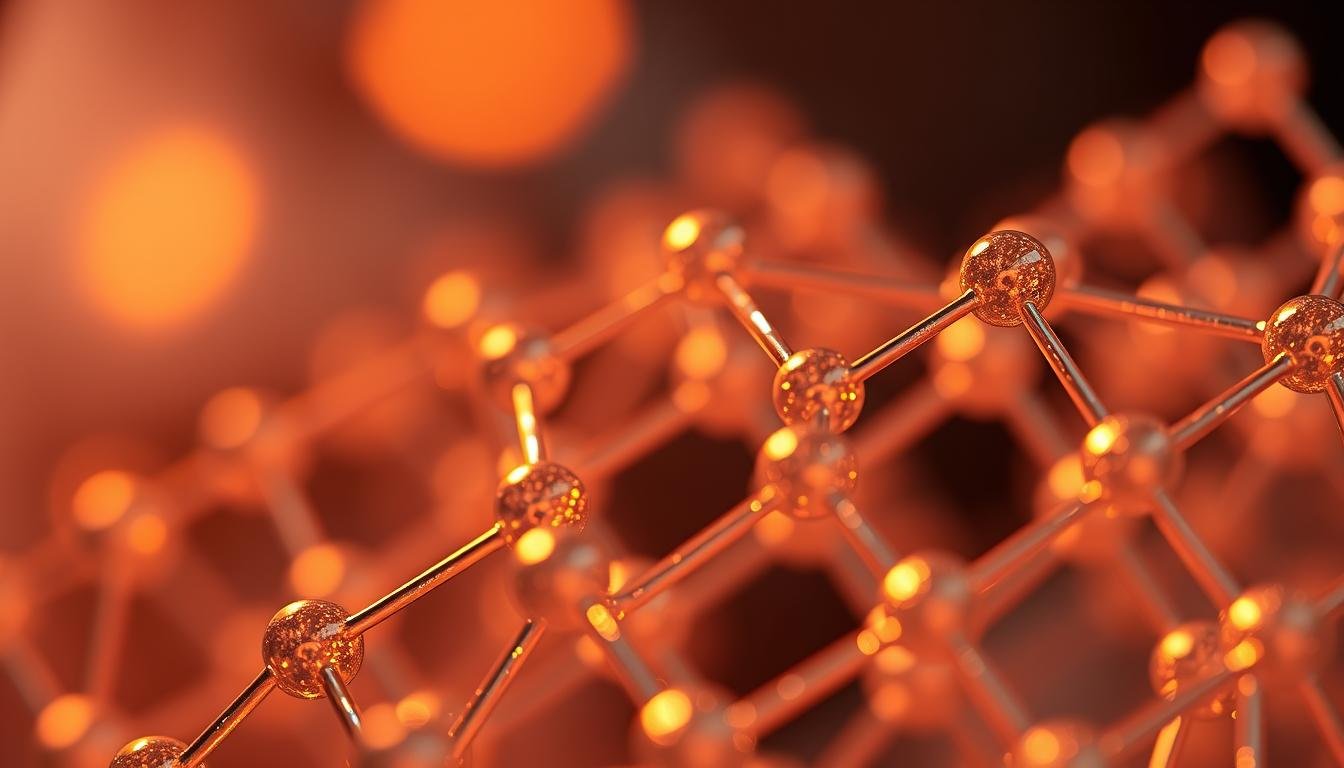
At the heart of modern technology lies an element with extraordinary thermal stability. Found in 27.7% of Earth’s crust, this versatile material powers everything from smartphones to solar farms. Its ability to withstand extreme heat—reaching temperatures above 1,400°C—makes it indispensable for high-performance industries.
As a metalloid in Group 14 of the periodic table, this element bridges the gap between metals and nonmetals. This unique position gives it semiconductor properties, enabling precise control of electrical currents. Engineers rely on these traits when designing microchips, photovoltaic cells, and heat-resistant alloys.
Thermal behavior varies significantly based on purity levels. Even minor impurities can alter performance in electronics manufacturing or metallurgy. Advanced purification techniques ensure consistency for critical applications like aerospace components or energy-efficient lighting systems.
Many confuse this element with synthetic polymers like silicone. While both have high-temperature resistance, their chemical structures and industrial uses differ dramatically. This guide clarifies these distinctions while exploring how thermal thresholds shape modern innovation.
Understanding Silicon: Elemental Basics and Characteristics
Second only to oxygen in Earth’s crust, this element forms the backbone of modern manufacturing. Positioned in Group 14 of the periodic table, it shares characteristics with carbon but behaves as a metalloid. This dual nature enables applications ranging from construction materials to quantum computing components.
Atomic Architecture and Natural Occurrence
With an atomic number of 14, the element contains 14 protons and 14 neutrons in its most common isotope. Three natural variants exist:
| Isotope | Natural Abundance | Neutron Count |
|---|---|---|
| Si-28 | 92.2% | 14 |
| Si-29 | 4.7% | 15 |
| Si-30 | 3.1% | 16 |
Material Behavior Under Standard Conditions
The physical properties include a density of 2.33 g/cm³ and diamond-like crystalline structure. Unlike metals, pure specimens exhibit semiconductor behavior at room temperature. Chemical properties show predictable tetravalent bonding patterns with oxygen and halogens.
Industrial applications leverage these traits through precise engineering. From solar panel substrates to alloy additives, the element’s stability under stress makes it irreplaceable in high-tech sectors.
Exploring Silicon Melting Point: Properties and Factors
Thermal thresholds determine how materials perform in cutting-edge technologies. For semiconductor-grade elements, maintaining structural integrity at extreme temperatures separates functional components from failed prototypes.
Role of Purity, Additives, and Chemical Composition
Ultra-high purity (99.9999%) specimens maintain precise thermal behavior. This standard prevents unpredictable shifts in high melting point performance during chip fabrication. Three factors dominate material engineering:
- Boron doping reduces electrical resistance
- Phosphorus additives enhance electron mobility
- Oxygen impurities alter crystal lattice stability
Metallurgical-grade variants tolerate 1-2% impurities for cost-effective alloy production. These compounds power solar panel substrates and heat-resistant engine parts.
Factors Influencing Thermal Thresholds
Crystalline defects create localized weak spots under thermal stress. Engineers combat this through:
- Directional solidification techniques
- Precision cooling protocols
- Grain boundary optimization
Such methods ensure uniform behavior across wafers, even near 1,400°C. The element’s chemical properties enable bonding with 64 other elements, creating specialized materials for aerospace and energy sectors.
High-Temperature Performance: Silicon Dioxide and Silicon Carbide
Advanced materials thrive under intense heat through innovative crystal structures and atomic bonding. Two compounds stand out for their ability to withstand extreme environments while maintaining functional integrity.
Melting Points and Thermal Stability of Silicon Dioxide
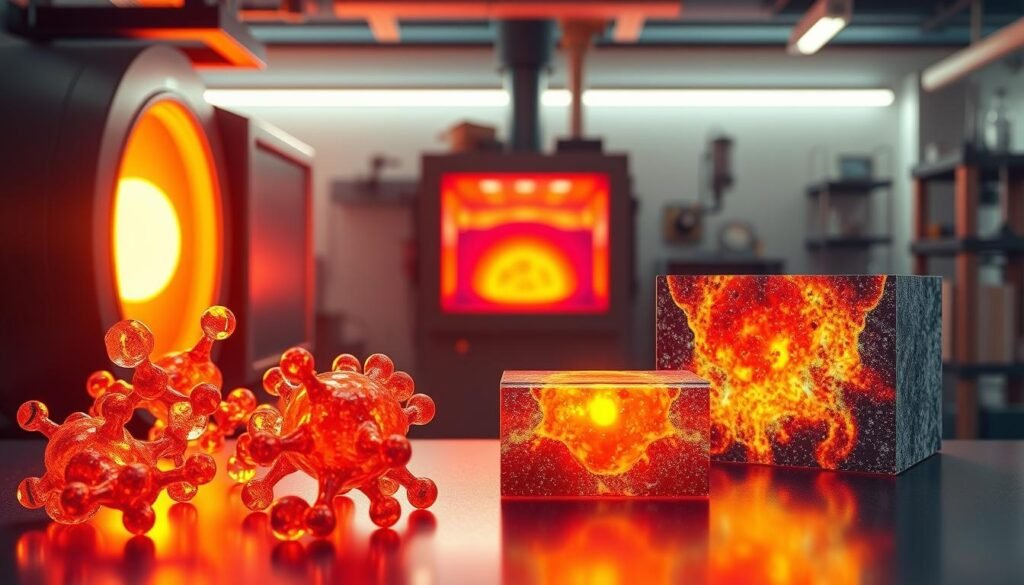
Silicon dioxide (SiO₂) maintains stability up to 1,710°C—ideal for glass production and industrial ceramics. Its quartz structure creates a rigid lattice that resists deformation under thermal stress. This property makes it essential for furnace linings and chemical reaction vessels.
Laboratory equipment manufacturers leverage SiO₂’s heat resistance for crucibles and optical components. The material’s transparency to infrared radiation further enhances its utility in high-temperature sensors.
Unique Properties of Silicon Carbide in Extreme Conditions
Silicon carbide (SiC) outperforms most materials with a melting point exceeding 2,700°C. Strong covalent bonds between atoms create an ultra-durable structure. This compound remains stable in aggressive chemical environments and mechanical wear scenarios.
Aerospace engineers use SiC for rocket nozzles and heat shields due to its thermal conductivity. Cutting tool manufacturers value its hardness—three times greater than tungsten carbide. These traits enable precision machining of superalloys in energy-intensive industries.
Silicon in Electronics: Integrated Circuits and Semiconductor Devices
Modern electronics owe their existence to a material that transformed how we process information. Its unique ability to balance conductivity and insulation forms the backbone of every smart device. This dual behavior enables precise control over electrical signals at microscopic scales.
Semiconductor Characteristics and Applications
The element’s semiconductor properties emerge when doped with specific impurities. Boron or phosphorus atoms alter electron flow, creating pathways for current regulation. These modifications produce two critical material types:
| Dopant Type | Element | Effect |
|---|---|---|
| P-Type | Boron | Creates electron deficiencies |
| N-Type | Phosphorus | Adds free electrons |
Combining these layers forms transistors—the building blocks of integrated circuits. Advanced manufacturing techniques stack billions of these components onto fingernail-sized chips. Solar panels use similar principles, converting sunlight into electricity through precisely engineered crystals.
Innovations in Integrated Circuit Design
Engineers now push boundaries with three-dimensional chip architectures. These designs improve performance while managing heat generated by dense component arrays. Key breakthroughs include:
- 3D transistor structures reducing energy loss
- Ultra-thin wafer production methods
- Error-correcting circuit layouts
Cutting-edge semiconductor devices leverage the material’s thermal resilience during production. Extreme ultraviolet lithography etches patterns smaller than viruses, enabled by the substrate’s stability under intense processing conditions. Such innovations drive progress in artificial intelligence and quantum computing hardware.
Advanced Applications: Solar Energy, Metallurgy, and High-Temperature Alloys
Modern industries demand materials that excel under stress while enabling sustainable solutions. Two fields showcase this element’s versatility: renewable energy systems and industrial material science. Both rely on precise engineering to maximize performance under operational extremes.
Powering the Future Through Sunlight Capture
Thin electronic-grade crystals transform sunlight into electricity with remarkable efficiency. These photovoltaic cells require ultra-pure specimens grown at carefully controlled temperatures. Solar energy systems maintain peak performance even when surface temperatures exceed 60°C during operation.
Manufacturers use advanced production methods to create wafer-thin layers. These processes preserve electrical properties critical for energy conversion efficiency. Recent innovations reduce waste by recycling excess material during slicing.
Reinventing Industrial Material Science
Aluminum and magnesium alloys gain strength when combined with this element. Automotive engines use these blends to withstand prolonged heat exposure. Aerospace components benefit from improved resistance to thermal fatigue.
In glass manufacturing, the material’s stability allows precise control during melting stages. This enables creation of optical-grade products for lasers and telescopes. Metallurgic-grade variants serve as raw material for industrial seals and high-performance lubricants.
Cutting-edge alloys now integrate nano-scale structures. These developments push temperature limits in power plant turbines and electric vehicle batteries. Each advancement demonstrates the element’s role in solving modern engineering challenges.
Comparative Insights: Distinguishing Silicone Melting Behavior
Material confusion between elemental and polymer forms leads to critical errors in industrial applications. Understanding thermal thresholds requires examining molecular architecture and degradation patterns across temperature ranges.
Understanding the Differences Between Silicon and Silicone
Silicon exists as a crystalline element, while silicone combines silicon with oxygen, carbon, and hydrogen through polymer chains. This structural contrast creates divergent thermal responses:
| Characteristic | Silicon | Silicone |
|---|---|---|
| Base Material | Element (Si) | Polymer (Si-O-C-H) |
| Thermal Threshold | 1,414°C | 80-250°C |
| Failure Mode | Sharp phase transition | Gradual softening |
Industrial seals and medical devices use silicone’s flexibility, whereas microchips require silicon’s rigid structure. Engineers must consider these properties when designing components for thermal extremes.
Thermal Stability and Degradation Patterns in Silicone
Silicone maintains functionality across wider temperature ranges than most polymers. Specialized formulations achieve peak performance through molecular engineering:
| Silicone Type | Operating Range | Degradation Onset |
|---|---|---|
| Standard Gel | -50°C to 200°C | 220°C |
| High-Temp Rubber | -60°C to 250°C | 270°C |
Unlike elemental counterparts, silicone experiences resistance loss through chain scission rather than melting. For detailed silicone melting point specifications, consult material datasheets. Advanced variants incorporate phenyl groups to delay breakdown in aerospace applications.
Conclusion
From microchips to solar panels, materials science relies on elements with exceptional thermal resilience. Silicon stands out for maintaining structural integrity at 1,414°C, a critical threshold enabling modern electronics and industrial systems. This metalloid’s unique position in the periodic table allows versatile bonding, forming compounds essential for heat-resistant alloys and semiconductor devices.
As the second most abundant element in Earth’s crust, silicon’s availability drives sustainable innovation. Its boiling point of 3,265°C further expands high-temperature applications, from aerospace components to energy-efficient lighting. Engineers optimize these properties through precise doping and crystal growth techniques.
Understanding thermal limits separates theoretical potential from real-world functionality. Silicon dioxide and carbide demonstrate how atomic arrangements enhance performance under stress. These advancements underscore the element’s role in pushing technological boundaries while maintaining ecological balance.