
Quartz is a hard, crystalline mineral made of silicon dioxide (SiO2). It makes up a big part of Earth’s crust. The properties of quartz are shaped by its quartz density. This density is key to understanding its strength and many uses in different fields.
The significance of quartz density is huge. It affects not just how long materials last but also how well they work. This is important in fields like material science and geology. We will look into the main points of quartz density, including where it’s found and how it varies.
Introduction to Quartz
Quartz is one of the most common minerals in the Earth’s crust. It is known for its durability and stability. These qualities make it a key part of many geological formations.
Quartz is formed through geological processes. It can be clear, purple (amethyst), or pink (rose quartz). The properties of quartz make it resistant to weathering and chemical changes. This is why it’s found in both igneous and sedimentary rocks.
Quartz has played a big role in human history. It has been used for making tools and as a decorative element in jewelry. Its hardness and availability make it valuable across many industries.
Understanding Quartz Density
Exploring quartz density helps us understand its physical properties and uses. The definition of quartz density is the mass per unit volume of this mineral. It’s a key factor in its use in fields like geology and materials science.
Definition of Quartz Density
Quartz density shows how compact quartz is. High-purity quartz usually has a density of about 2.65 g/cm³. But, impurities or changes in its structure can affect its density. This variation is important for its precise use.
Measurement Techniques
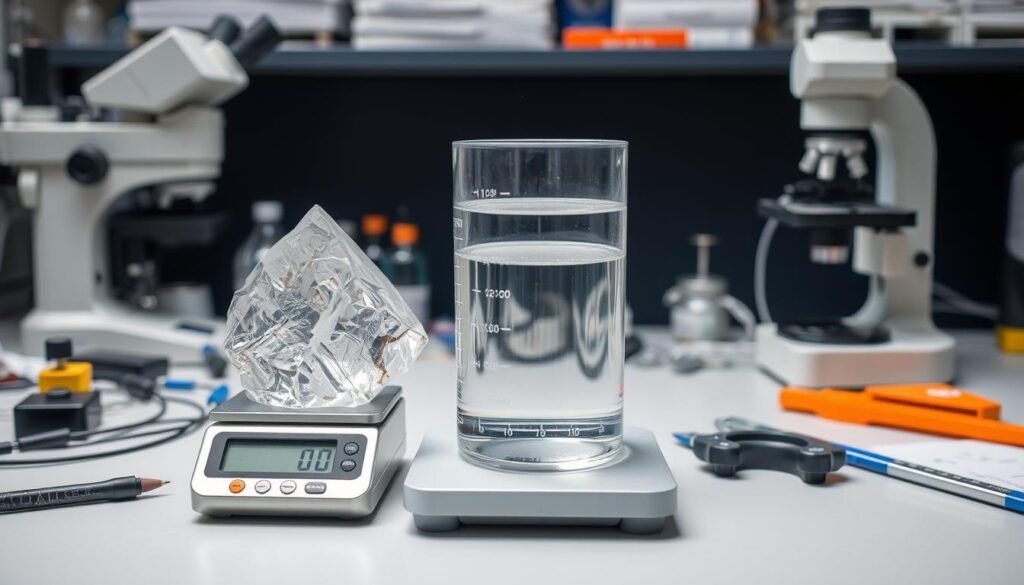
To measure quartz accurately, several methods are used. The Archimedes principle is one. It involves weighing quartz in air and then in water. The difference in weight helps calculate its density.
Another method is pycnometry. It uses a calibrated liquid to find the volume of quartz. This method also gives a reliable density reading.
| Method | Description | Application |
|---|---|---|
| Archimedes Principle | Measures weight loss when submerged in water. | Commonly used in laboratories for accuracy. |
| Pycnometry | Uses a calibrated liquid for volume displacement. | Effective for precise density calculations in research. |
Physical Properties of Quartz
Quartz has unique physical properties that help us understand its uses. Its crystal structure and hardness are key. These traits affect how quartz works in different settings.
Crystal Structure and Form
The quartz crystal structure falls under the trigonal system. It has a hexagonal prism shape. Often, crystals end in pyramid-like structures, showing either single prisms or large groups.
This special structure leads to beautiful formations like quartz geodes. These formations show the mineral’s complex beauty.
Hardness and Tenacity
Quartz is very hard, with a rating of 7 on the Mohs scale. This means it’s very durable and resistant to scratches. It breaks in a conchoidal pattern, showing brittleness under pressure.
But, its lack of cleavage makes it tough. This allows quartz to withstand stress and keep its shape. Its durability makes it valuable in many industries, as studies on its physical properties show.
Chemical Composition of Quartz
Quartz is mainly made up of silicon dioxide (SiO2). This mix forms a strong structure of SiO4 tetrahedra. These tetrahedra are arranged differently, leading to various quartz types, each with its own features.
Impurities affect quartz’s color and look. For example, iron makes amethyst purple, and aluminum gives citrine its yellow color. This shows how chemical makeup changes quartz’s appearance and properties.
The purity of SiO2 makes quartz valuable in many fields. It’s used in electronics and jewelry because of its unique qualities. Knowing quartz’s chemical makeup helps us use it to its fullest.
Importance of Quartz Density in Material Science
Quartz density is key in material science. It affects strength, stability, and durability. Knowing this helps pick the right materials for different uses.
In optical tools, quartz’s specific gravity is critical for top performance. Building materials also rely on quartz density for safety and green design. Using quartz in material science sets standards in many fields.
| Property | Relevance to Material Science |
|---|---|
| Density | Critical for strength and durability assessments |
| Specific Gravity | Aids in material selection for engineering applications |
| Mechanical Properties | Influences performance in various environments |
| Thermal Stability | Essential for high-temperature applications |
Applications of Quartz Density in Various Industries
Quartz density is key in many industries because of its special properties. It’s used a lot in making semiconductors and optical tools. This part talks about how quartz is important in these areas.
Usage in Semiconductor Manufacturing
In the semiconductor world, quartz glass is a must. It’s needed for parts that need to be very precise and can handle high temperatures. Its low density and high purity make it great for wafer carriers and etch chambers.
These parts are critical for making microchips. The quality of these chips depends on how well these parts work.
Role in Optical Instruments
Quartz glass is also vital for optical tools because of its clearness and special density. It’s used in UV lights and laser systems. Quartz can keep working well even when it gets hot or cold, making it perfect for high-precision optical instruments.
This makes quartz very useful for improving technology in many fields.
| Industry | Application | Benefits |
|---|---|---|
| Semiconductor | Wafer carriers & etch chambers | High temperature and chemical resistance |
| Optical Instruments | UV lighting & laser systems | Optical clarity & stability under temperature changes |
Factors Influencing Quartz Density
Quartz density changes due to several factors. These factors affect how quartz behaves in different situations. They include impurities and temperature effects.
Impurities and Varieties
Impurities like iron, aluminum, or other elements change quartz density. These impurities create different types of quartz. Each type has its own physical traits.
For example, colored quartz like amethyst or citrine has different densities than pure quartz. The type and amount of impurities affect both its look and its use in industry.
Temperature and Transformation
Temperature changes affect quartz, altering its density. At about 573 °C, α-quartz turns into β-quartz. This change causes volume and density shifts.
This transformation can also cause microfractures in rocks. It impacts their stability and density. Knowing about temperature effects helps in understanding quartz behavior in various settings.
Quartz Density and Environmental Impact
Quartz mining affects the environment, mainly because of its density. Mining can release dust that includes crystalline silica. This dust is harmful if inhaled, posing health risks to workers and nearby communities.
Knowing about quartz density is key to understanding its environmental impact. Quartz density affects how it interacts with soil and water. This is important when quartz is used in construction. It can change soil erosion and habitat stability.
It’s important to watch how quartz interacts with the environment. Using sustainable mining practices can reduce harm to ecosystems. It also keeps workers safe during quartz extraction.

Comparative Analysis with Other Silica Minerals
Comparing silica minerals shows interesting differences. Quartz has a density of about 2.65 g/cm³ at standard conditions. Tridymite’s density ranges from 2.22 to 2.26 g/cm³. Cristobalite’s density is slightly lower, with α-cristobalite between 2.32-2.38 g/cm³ and β-cristobalite from 2.27-2.33 g/cm³.
Coesite, a high-pressure form of silica, has a density of around 2.92 g/cm³. This highlights the differences in structure and stability among these minerals. Stishovite, another high-pressure polymorph, has a density of about 4.29 g/cm³. This makes it stand out from quartz.
Knowing these differences helps us choose the right materials for different uses. For more information, researchers can look at mineralogy studies. Understanding how quartz and other silica minerals work together helps us grasp their roles, even in extreme conditions.
Conclusion
Understanding quartz density is key. It shows the mineral’s physical and chemical sides. These traits are important for its use in many fields, like electronics and construction.
Studying quartz density shows its impact on material science and its role in nature. It’s not just about its properties. It’s also about how it affects our world.
Quartz’s unique qualities make it important in both natural and man-made settings. It’s not just a rock; it’s a key player in today’s industries. Its significance is clear, and it will keep growing as we learn more.
Quartz density is a mix of natural wonder and practical use. It’s a starting point for more research and use. As technology changes, knowing about quartz will help it stay useful in many areas.