
Polycarbonate is a strong thermoplastic known for being light and resistant to impact. It’s widely used in many fields. Knowing about polycarbonate density is key because it affects how well it works and lasts.
With a density of 1.20 g/cm³, polycarbonate’s density is important. It helps decide if it’s good for things like safety glasses or car parts. This article will dive deep into polycarbonate density, including how to measure it and what affects it.
It will also look at its many uses. For more on polycarbonate and its features, check out this resource.
What is Polycarbonate?
Polycarbonate, often called PC, is a type of plastic. It has carbonate groups in its structure. This makes it strong, versatile, and clear.
It can handle high temperatures well. This makes it good for many uses.
Polycarbonate is tough, light, and stays stable in heat. It works well from -40°F to 240°F. This makes it easy to shape and mold.
It’s used in many products. For example, in car parts and safety gear. Its light weight is also a big plus.
Basic Characteristics of Polycarbonate
Polycarbonate is known for its unique features. One key trait is its impact resistance. It’s much stronger than glass and many metals, showing over 200 times the strength of glass.
It also has excellent optical clarity. Polycarbonate can let up to 90% of light through. This makes it great for safety glasses, lenses, and protective barriers.
Its thermal stability is another plus. It works well in extreme temperatures. This means it keeps its strength in both hot and cold conditions. Its light weight and resistance to UV radiation also make it useful in many areas.
For more details on polycarbonate’s characteristics, it’s clear why it’s popular in many fields.
Polycarbonate’s Common Uses
Polycarbonate is known for its versatility. It is used in many industries because of its special properties. It is found in construction, automotive, electronics, and medical fields.
In polycarbonate in construction, it’s used for roofing sheets and security glazing. These products are strong and let natural light in. They make spaces look good and are safe.
The car industry uses polycarbonate for making parts that are light and strong. Things like headlight covers and interior panels are made from it. This helps make cars safer and more fuel-efficient.
In electronics, polycarbonate is used for screens and protective cases. It’s tough and protects devices well. In medicine, it’s used because it’s clean and safe for medical tools.
Polycarbonate vs. Other Plastics
In a polycarbonate comparison, polycarbonate stands out. It beats other plastics like PMMA, polystyrene, and polypropylene in many ways. For example, its tensile strength is about 60 MPa, much higher than polystyrene’s 40 MPa.
Acrylic can get up to 70 MPa, but polycarbonate’s impact resistance is unmatched. It can handle forces over 850 J/m, while polypropylene only manages about 100 J/m.
The advantages of polycarbonate go beyond just strength. It stays strong in a wide range of temperatures, from -40°F to 240°F. This makes it perfect for tough conditions.
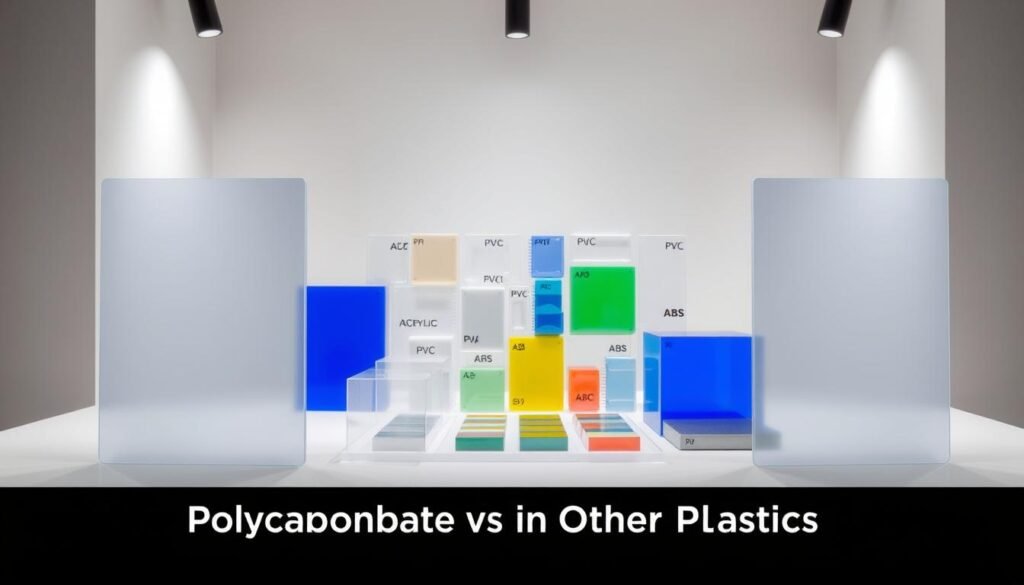
Looking at polycarbonate vs. PMMA, PMMA might be clearer. But polycarbonate wins in key areas for industrial use. Its strength, impact resistance, and thermal stability make it great for tough environments.
How is the Density of Polycarbonate Measured?
Understanding the density of polycarbonate is key to knowing its properties and uses. There are several ways to measure its density accurately. This section will look at these methods and the units used.
Methods of Measurement
There are a few trusted ways to find out the density of polycarbonate. Archimedes’ principle is one, where the volume of a polycarbonate sample is found when it’s submerged in water. This method uses the formula Density = mass/volume to calculate density.
Another good method is the displacement technique with a graduated cylinder. It gives precise volume measurements. For even more accuracy, density meters or pycnometers can be used. They allow for direct density measurement.
Units and Conversion Factors
Density is often shown in kilograms per cubic meter (kg/m³) or grams per cubic centimeter (g/cm³). Knowing these units is important for correct data understanding.
There’s a conversion factor: 1 g/cm³ is equal to 1000 kg/m³. This helps compare different density measurements.
| Measurement Method | Description | Advantages |
|---|---|---|
| Archimedes’ Principle | Submerging the sample in water to measure volume | Simple and effective for solids |
| Displacement Technique | Using a graduated cylinder to determine volume displacement | Accurate for both small and large samples |
| Density Meters/Pycnometers | Direct measurement of mass and volume | Highly precise and quick results |
Factors Affecting the Density of Polycarbonate
Understanding the density of polycarbonate involves looking at thermal and environmental factors. How it reacts to temperature changes is key. This affects its performance in different uses.
Thermal and Environmental Influences
When temperatures go up, polycarbonate gets bigger and its density goes down. On the other hand, cooler temperatures make it shrink and its density goes up. These thermal influences on density are important for its use.
Also, things like humidity can add moisture to polycarbonate. This changes its density. Such changes make it harder to predict how well it will perform.
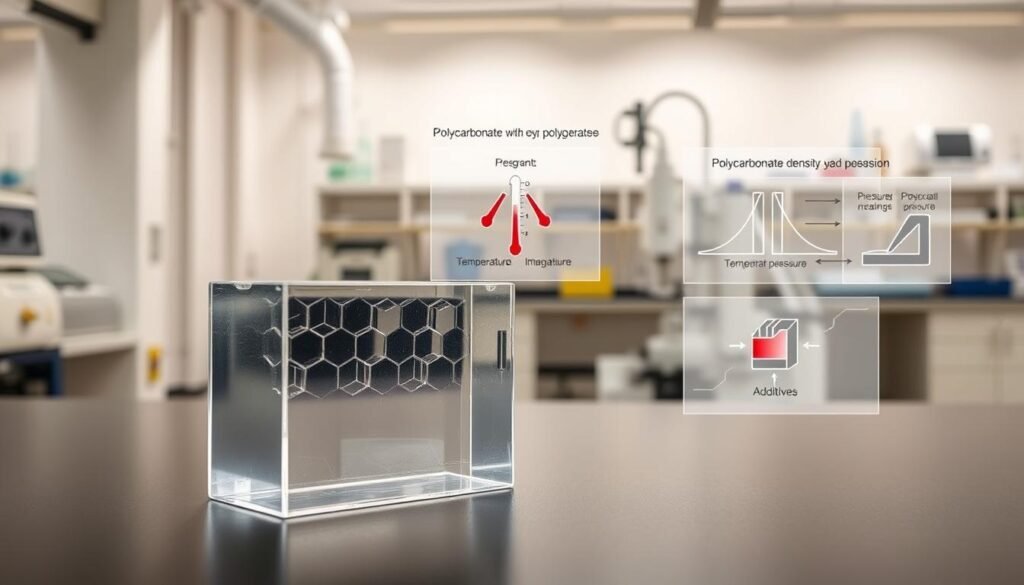
The mix of materials in polycarbonate also matters. Different additives can change its density. Too much of any additive can make a big difference.
How well the material is made also affects its density. The way particles mix and the ratio of materials can change its density. Knowing this helps predict how polycarbonate will behave. Learn more about density influencing factors here.
| Condition | Density Effect |
|---|---|
| High Temperature | Decreases Density |
| Low Temperature | Increases Density |
| High Humidity | Can Decrease Density |
| Polymer Blend Additives | Varies Density Based on Type |
Typical Density Values for Polycarbonate
The density of polycarbonate is key to its use and how well it works. It usually has a density between 1.18 and 1.22 g/cm³. Knowing these values helps pick the right polycarbonate for the job.
Different Grades Density Values
Polycarbonate comes in different types, each for a specific need. This leads to various densities:
| Grade of Polycarbonate | Typical Density (g/cm³) |
|---|---|
| General-Purpose Polycarbonate | 1.20 |
| Impact-Resistant Polycarbonate | 1.22 |
| Ultra-Light Polycarbonate | 1.18 |
These different densities let engineers and designers pick the best material. This ensures their projects work well and last long.
Applications of Polycarbonate Based on Density
The density of polycarbonate is key in its uses across many industries. High-density polycarbonate is great for places needing top strength and durability. It’s often used in engineering plastics, like in cars and planes.
It’s perfect for parts that face a lot of stress, like car frames and protective covers. This is because it’s very strong.
On the other hand, low-density polycarbonate is used where weight is a big deal. For example, in car parts like headlamp lenses. Here, it’s all about being light yet strong.
This helps cars run better and use less fuel. It’s a big win for car makers.
Food packaging and storage also use polycarbonate, but in a safe way. Food-grade polycarbonate meets safety rules and is strong yet light. It’s great for containers because they’re easy to carry and move.
Physical Properties Related to Density in Polycarbonate
The physical properties of polycarbonate are key to its use in many areas. Its density affects its strength and impact resistance. For example, polycarbonate is much tougher than glass and acrylic. It can handle impacts 200 times better than regular glass.
Density also impacts thermal stability. Polycarbonate works well in temperatures from -40°C to 115°C. This is vital for materials that need to perform well in harsh conditions. Learn more about how density affects polycarbonate’s use here.
| Property | Polycarbonate | Glass | Acrylic |
|---|---|---|---|
| Impact Resistance | 200 times greater | Baseline | Less than glass |
| Operating Temperature Range | -40°C to 115°C | -40°C to 80°C | -30°C to 80°C |
| Density (g/cm³) | 1.2 – 1.22 | 2.5 | 1.19 |
Polycarbonate Material Density Explained
Understanding polycarbonate material density is key in many industries. It affects how durable and efficient a product is. It also impacts recycling, which is important for sustainability.
Polycarbonate density insights show how it reacts to temperature and humidity changes. This knowledge helps professionals make better choices for their projects. It’s vital in harsh environments.
Knowing the density properties of polycarbonate helps predict its performance over time. Products made from it face various stresses. Understanding its density ensures they are reliable and efficient.
Conclusion
Polycarbonate density is key in many fields, like consumer goods and industry. Knowing how to measure it helps makers and designers use it best. This knowledge is vital for getting the most out of polycarbonate.
Polycarbonate is very versatile, but knowing its density is essential. As new ways to make and use it come up, knowing about density is more important than ever. This knowledge helps make products better and more reliable.
Understanding what affects density helps in making better polycarbonate products. As the world of materials keeps changing, knowing about polycarbonate density will always be important.