
In materials science, knowing about plastic density is key. Plastic density is how much a certain amount of plastic weighs. It affects things like how heavy it is, how strong, and where it can be used.
Getting to know plastic density is important for making things better. It helps in designing and making products. This knowledge is vital for improving how things are made.
Knowing plastic density helps engineers pick the right materials. This knowledge is important for making good products. There are ways to measure plastic density, like the displacement method and thickness gauge method.
To learn more about measuring plastic density, check out this comprehensive resource.
Introduction to Density in Materials Science
Density is a key property in materials science density. It’s the mass of an object divided by its volume. The Greek letter rho (ρ) represents it. Density is measured in kg/m³ for the metric system or lb/ft³ for the imperial system.
Knowing the importance of density helps us understand how materials act under different conditions. It’s vital for making choices about materials.
The basics of density give us insights into material selection and performance. It affects things like buoyancy, thermal conductivity, and strength. For instance, lighter materials are better for the aerospace industry because they’re strong yet light.
In plastics, the way atoms are arranged changes density. This affects their use in various fields.
To learn more about density, including how to measure and use it, check out educational materials. Understanding these basics helps us explore specific materials, like plastics. Density is key in making new and useful plastics.
Defining Plastic Density
Understanding plastic density is key in materials science. It helps us judge how well materials work in various settings. This section explains what density is and its big role in the field.
What is Density?
Density is the mass of something divided by its volume, shown as ρ = m/V. It shows how tightly packed a material is. This affects its weight and how it floats. Knowing about density helps makers and designers pick the right materials.
The Importance of Density in Material Properties
Density tells us a lot about a material’s traits. It affects a material’s strength, durability, and how it conducts heat. For example, lighter plastics are good for when you need something not too heavy. But denser plastics are stronger and better at handling impacts.
Getting density right helps engineers and designers choose the best materials. This makes things work better and last longer.
| Material Type | Density (g/cm³) | Common Applications |
|---|---|---|
| Low Density Polyethylene (LDPE) | 0.91 – 0.94 | Bags, plastic wraps |
| High Density Polyethylene (HDPE) | 0.94 – 0.97 | Bottles, piping |
| Polyvinyl Chloride (PVC) | 1.3 – 1.45 | Construction materials |
| Polystyrene | 1.04 – 1.06 | Packaging, insulation |
Calculating Plastic Density
Understanding plastic density involves knowing how mass and volume relate. Accurate density measurement is key. It helps in characterizing materials for different uses.
The Bulk Density Formula
The bulk density formula is a basic tool for plastic density assessment. It’s simple: D = M / V. Here, D is density, M is mass, and V is volume. This formula helps turn plastic properties into useful data for engineers and material selectors.
Experimental Methods for Measuring Density
Using the right methods is vital for precise density results. There are several ways to measure plastic density, including:
- Testing solid plastics in water to see how they float.
- Measuring in liquids other than water to understand density better.
Each method offers important insights and ensures accurate density measurements. In labs, tools like scales and graduated cylinders are essential. For more on plastic density, check out this resource.

Factors Affecting Plastic Density
The density of plastic changes due to its composition and the temperature around it. The plastic composition affects how tightly molecules are packed, altering density. Temperature also plays a big role, changing how molecules are arranged and affecting temperature impact on density.
Composition of Plastics
The factors influencing plastic density start with the polymers’ chemical structure and additives. Different polymers have different densities. Switching polymers or adding fillers can greatly change plastic density.
Plastics like polyethylene or polypropylene have unique plastic composition. This affects their use in various fields, from packaging to car parts.
Effect of Temperature on Density
Temperature changes affect plastic density. Heating plastics can expand their chains, possibly lowering density. Cooling can contract them, raising density.
It’s key to understand this temperature impact on density for precise material performance. Knowing density at different temperatures helps predict material behavior under different conditions.
| Temperature (°C) | Density of Polyethylene (g/cm³) | Density of Polypropylene (g/cm³) |
|---|---|---|
| 20 | 0.92 | 0.90 |
| 40 | 0.91 | 0.89 |
| 60 | 0.89 | 0.88 |
Applications of Plastic Density in Industry
Plastic density is key in many industries, from packaging to car design. It affects how strong, light, and useful plastic products are. This knowledge helps designers make better materials for their needs, making products more efficient.
Impact on Product Design
Plastic density greatly impacts product design. Denser plastics are stronger and last longer, perfect for car parts or heavy equipment. For example, Polycarbonate is great for areas needing to withstand a lot of impact.
On the other hand, lighter plastics like Polypropylene are better for packaging. They help save money by reducing the weight of items, which means less cost for shipping.
Influence on Manufacturing Processes
How plastics are made depends a lot on their density. Different plastics process differently, affecting how they’re shaped and molded. For instance, HDPE is great for blow molding, making production faster and cheaper.
Density also affects how materials are handled during making. This can change how much energy is used and how productive the process is.
Understanding density’s role in making plastics can make things more affordable. For example, using PET can cut down on production costs. It’s also cheaper to ship because it’s lighter than glass.
Learn more about plastic density and its uses in this article about plastic density and its industrial applications.
| Type of Plastic | Density (g/cm³) | Key Applications |
|---|---|---|
| PET | 1.3 – 1.4 | Bottles, Containers |
| HDPE | 0.94 – 0.97 | Milk Jugs, Detergent Bottles |
| LDPE | 0.91 – 0.93 | Plastic Bags, Squeeze Bottles |
| PP | 0.89 – 0.91 | Automotive Parts, Textiles |
Plastic Density and Environmental Considerations
The way plastic density affects the environment is key to better recycling and sustainability. Knowing how plastic density impacts recycling helps manage waste better. It also helps create products that are easier to recycle.
Recycling and Sustainability in Plastics
Plastic recycling is shaped by plastic density. Different plastics have different densities, affecting recycling. For example, lighter plastics float, while denser ones sink, making sorting harder.
Sustainability in plastic manufacturing depends on using materials that harm the environment less. These materials should also improve recycling chances.
Evaluating Biodegradable Plastics
Biodegradable plastics are seen as a green option compared to regular plastics. Their density is important for their environmental effect. Lower density biodegradable plastics can break down faster in nature, helping meet sustainability goals.
Choosing the right density for biodegradable plastics is key. It ensures they are eco-friendly and meet industry standards.

Comparing Plastic Density with Other Materials
It’s important to know how plastic density compares to other materials for choosing the right one. Plastics are versatile but often lighter than metals, wood, and ceramics. This difference affects how well they perform, last, and where they can be used.
The table below shows a comparison of plastics, metals, wood, and ceramics by density:
| Material | Typical Density (g/cm³) |
|---|---|
| Low Density Polyethylene (LDPE) | 0.92 – 0.93 |
| High Density Polyethylene (HDPE) | 0.94 – 0.97 |
| Aluminum | 2.70 |
| Steel | 7.85 |
| Pine Wood | 0.35 – 0.55 |
| Porcelain | 2.20 – 2.50 |
Plastics are much lighter than metals, which is why they’re great for things like packaging and car parts. On the other hand, materials like steel are denser and stronger, making them better for building things.
Knowing how plastic density compares to other materials helps pick the best material for a project. Designers and engineers need to think about these differences to make sure materials work well together.
Specific Types of Plastics and Their Densities
Knowing about the different plastics and their densities is key in making products. Each plastic has its own set of properties because of its density. This makes some plastics better for certain jobs than others.
Low Density Polyethylene (LDPE)
LDPE, or Low Density Polyethylene, has a density between 0.910 to 0.940 g/cm3. It’s known for being flexible and strong. This makes it great for things like plastic bags, containers, and packaging.
LDPE’s lower density means it’s not as stiff. It’s more bendy, which is good for things that need to stretch and move easily.
High Density Polyethylene (HDPE)
HDPE, or High Density Polyethylene, has a density of 0.941 to 0.965 g/cm3. It’s denser than LDPE, making it stronger. HDPE is used in bottles, pipes, and furniture because it’s tough and can handle impacts well.
HDPE’s higher density also makes it last longer and be more resistant to the environment.
| Type of Plastic | Density (g/cm3) | Key Properties | Common Applications |
|---|---|---|---|
| Low Density Polyethylene (LDPE) | 0.910 – 0.940 | Flexible, ductile | Plastic bags, wrappers, containers |
| High Density Polyethylene (HDPE) | 0.941 – 0.965 | Strong, impact-resistant | Bottles, piping, durable containers |
Density Measurement Techniques in the Plastic Industry
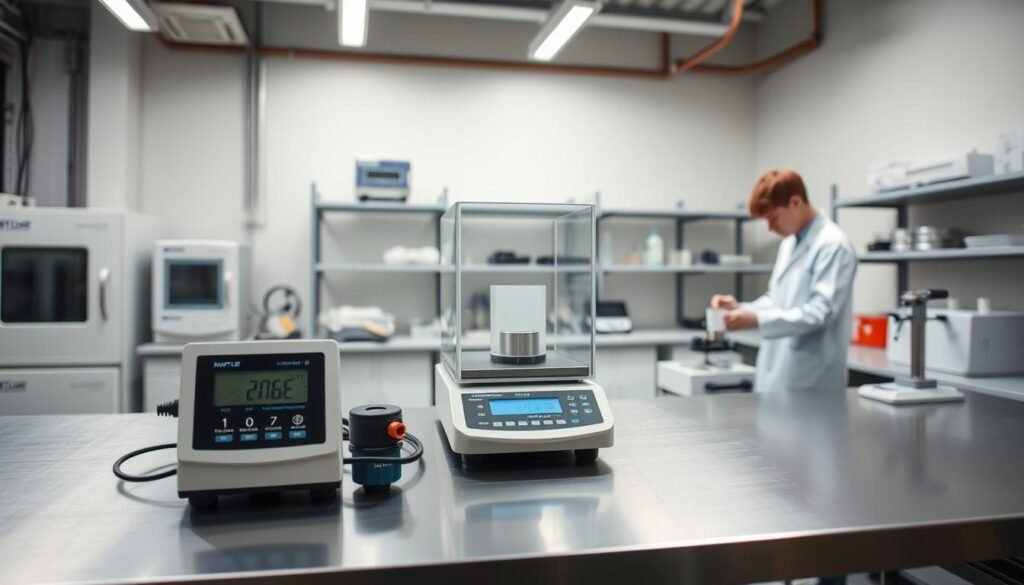
In the plastic industry, knowing the density is key for quality control and meeting standards. Two main ways to measure plastic density are the displacement method and the thickness gauge method. These methods help understand the material’s properties and how they affect product performance.
Displacement Method
The displacement method finds the plastic’s volume by measuring the liquid it displaces. This method is accurate and works well for many plastics. It’s great for quick density checks, even with odd-shaped samples.
Thickness Gauge Method
The thickness gauge method uses special tools to measure plastic thickness, helping calculate density. It’s good for standard-sized plastics, giving fast and consistent results. This method can also be part of automated systems, making density checks easier in manufacturing.
Challenges in Measuring Plastic Density
Measuring plastic density is tricky. One big problem is the variability in plastic composition. This happens because of different additives used in production. These additives can change the density and make it hard to get consistent measurements.
Variability in Plastic Composition
Different makers use different materials and formulas. This leads to big differences in the final product. It makes it hard to get accurate density readings.
Reliable density readings are key for plastic quality and performance. Even small changes in the formula can affect the density. This makes it tough for makers to keep standards the same.
To tackle these issues, we need better techniques and a deep understanding of plastics’ chemistry. Keeping an eye on how plastic composition changes is vital. It helps improve accuracy and product quality.
Future Trends in Plastic Density Research
The future of plastic density research is changing a lot. This is because of new things happening in materials science. Scientists are working hard to understand how different plastics can meet new needs in many industries.
They want to make materials better for performance and the planet. This will help make things work more efficiently.
Innovations in Material Science
New things in materials science are helping plastic density research a lot. Scientists are finding new ways to change plastic densities. They are using new ways to make plastics, like additive manufacturing and nanomaterials.
These new plastics can be lighter, stronger, and more flexible. This could help cars use less fuel because they are lighter.
Development of New Plastic Materials
New plastic materials are being made to be better for the environment and strong. Bioplastics and composite materials are being made to be versatile. They meet many needs for being green.
Scientists are working to make these plastics even better. They want them to meet what people need and follow rules. As we make more of these plastics, we expect to see even more green innovations.
| Aspect | Current Trends | Future Outlook |
|---|---|---|
| Density Control | Standard plastic formulations | Custom-tailored density for specific applications |
| Material Development | Conventional polymers | Sustainable bioplastics and high-performance composites |
| Manufacturing Techniques | Traditional molding processes | Additive manufacturing and advanced processing methods |
| Environmental Considerations | Basic recycling practices | Enhanced recycling systems and biodegradable materials |
Conclusion
We’ve looked into how plastic density is key in materials science. It affects many industries in big ways. Knowing about plastic density helps in designing and making products better.
It’s also important for the environment. Engineers and designers need to understand density. This knowledge helps plastics work better and last longer.
Research keeps finding new ways to use plastic density. This helps make products that are good for the planet. It also tackles problems like recycling and waste.
As we move forward, plastic density will keep playing a big role. It will help make products better, more sustainable, and useful in many areas.