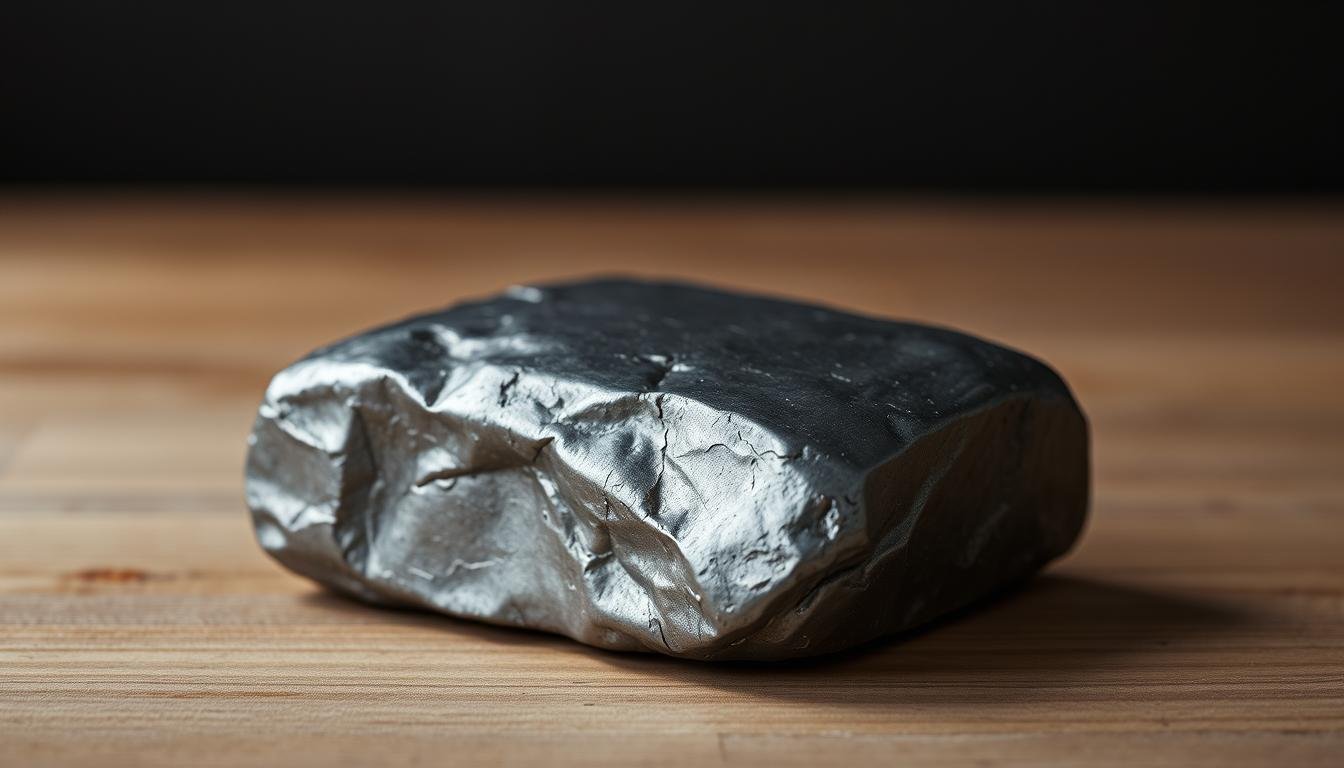
The density of lead is key in its many uses. It has a density of about 11.34 g/cm³, making it one of the densest metals. This high density comes from its atomic structure and how its atoms are arranged.
Knowing about lead’s density helps us understand its characteristics. It also shows its importance in fields like radiation shielding, battery making, and balancing weights.
This article will look into what lead’s density means. We’ll compare it to other metals and see how its unique properties are used in real-world applications.
Introduction to Lead and Its Characteristics
Lead is a heavy metal known for its high density, malleability, and resistance to corrosion. These traits make it valuable in many industries. It has an atomic number of 82 and an atomic weight of 207.2 u. This places lead as a key element in the periodic table and in technological progress.
Lead’s uses have changed over time. It was used in ancient times for pipes and cosmetics. Now, it’s used for radiation shielding in medicine and as weights in sports.
Lead’s unique properties and versatility keep it important today. It’s used in construction and electronic parts. This shows how valuable lead is in our modern world.
What is the Density of Lead and How is it Measured?
Lead has a density of about 11.34 g/cm³, making it very dense. Knowing how to measure lead density is key in engineering and manufacturing. It involves a density calculation based on the lead’s mass and volume.
To measure lead density, people use special containers and scales. They also use liquids to measure volume by displacement. This method helps get accurate density readings.
In labs, there’s another way to measure lead density. It involves using buoyancy to see how the sample floats. This method is a visual way to find out the density. For more on lead’s properties, see this detailed resource.
Exploring Lead’s Density Value in g/cm³
At room temperature, lead’s density is about 11.34 g/cm³. This makes lead one of the heaviest metals used today. Many studies have confirmed this density, showing its reliability in different uses.
Knowing lead’s density helps industries use it well for insulation and soundproofing. It also helps in designing products that need heavy materials. This knowledge is key for better engineering.
To show lead’s density, here’s a table comparing it with other metals:
| Metal | Density Value (g/cm³) |
|---|---|
| Lead | 11.34 |
| Iron | 7.87 |
| Aluminum | 2.70 |
| Copper | 8.96 |
| Zinc | 7.14 |
This table shows lead’s high density compared to other metals. It’s important for those who need to know exact material properties.
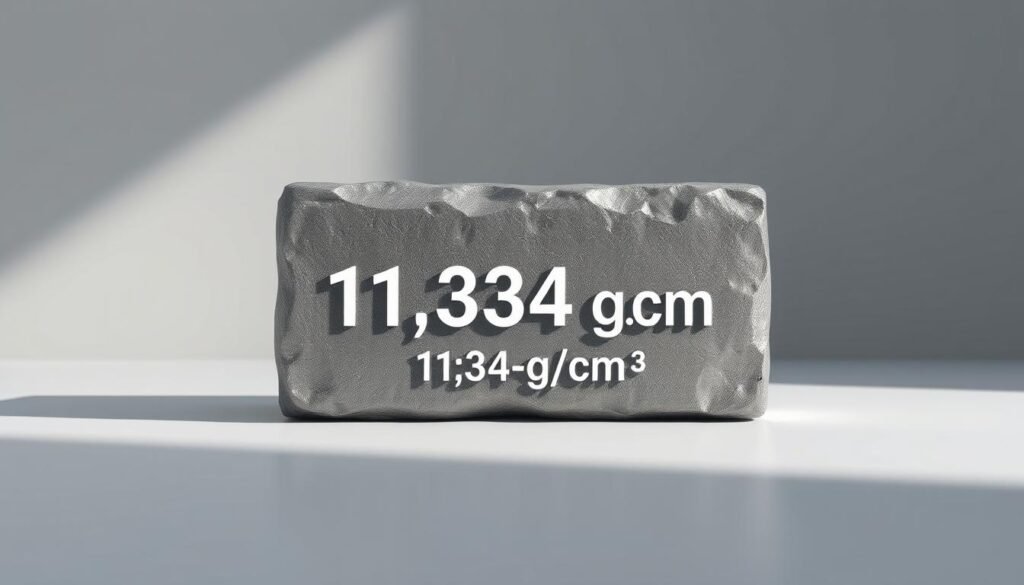
Comparing the Density of Lead to Other Common Metals
Lead has a density of 11.34 g/cm³, making it one of the denser metals. This is important when comparing metal densities. For example, aluminum is much lighter, with a density of 2.70 g/cm³. Steel’s density ranges from 7.75 to 8.05 g/cm³, which is also lower than lead’s.
Looking at other metals, copper has a density of 8.96 g/cm³, and tin is even lighter at 7.31 g/cm³. These comparisons show lead’s unique place among metals. It’s denser than many but not as dense as some.
When we look at even heavier materials, gold and tungsten have densities of 19.32 g/cm³ and 19.25 g/cm³ respectively. Lead is dense, but there are materials denser than it.
| Metal | Density (g/cm³) |
|---|---|
| Lead | 11.34 |
| Copper | 8.96 |
| Steel | 7.75 – 8.05 |
| Aluminum | 2.70 |
| Tin | 7.31 |
| Gold | 19.32 |
| Tungsten | 19.25 |
This look at metal densities shows lead’s importance in discussions about density. Knowing these differences helps us choose the right materials for different uses.
Why is Lead So Dense Compared to Other Materials?
Lead’s high density comes from its heavy atomic mass and unique atomic structure. It has 82 protons and 125 neutrons. This makes its atomic weight high, leading to a greater mass per unit volume than many other materials.
The way lead atoms are arranged in a face-centered cubic (FCC) lattice is key. This arrangement allows for efficient packing of atoms. It minimizes empty spaces in the material, boosting its density. The mass of each atom and how they are arranged are both important for lead’s density.
To show how atomic structure affects density, here’s a comparison of lead with other metals:
| Metal | Atomic Mass (g/mol) | Density (g/cm³) | Atomic Structure Type |
|---|---|---|---|
| Lead | 207.2 | 11.34 | Face-Centered Cubic |
| Iron | 55.85 | 7.87 | Body-Centered Cubic |
| Copper | 63.55 | 8.96 | Face-Centered Cubic |
| Zinc | 65.38 | 7.14 | Hexagonal Close-Packed |
Knowing these details helps us understand why lead is used in many industrial settings. It’s great for absorbing energy and adding weight. Lead’s unique properties make it perfect for certain jobs, showing how its structure and density are vital.
The Atomic Structure and Density of Lead
The atomic structure of lead is key to understanding its high density. It has an atomic mass of about 207.2 u. This makes lead very dense. The way lead atoms are arranged helps make it stable.
The way lead atoms are spaced affects its physical properties. This is important because density is critical in many uses. Studying lead’s atomic structure gives us insights into its practical uses.

| Property | Value |
|---|---|
| Atomic Mass | 207.2 u |
| Density | 11.34 g/cm³ |
| Melting Point | 327.5°C |
| Boiling Point | 1749°C |
Learning about lead’s atomic structure helps us understand its density better. It shows how important these features are in real-world uses. The connection between atomic arrangement and density is vital for industries that use lead.
How Lead Density Affects Its Applications in Various Industries
Lead’s unique density greatly impacts its uses in many fields. In healthcare, lead is key for shielding against harmful radiation. Doctors use it to protect patients and staff from x-rays and gamma rays.
In the automotive and energy sectors, lead’s density is also vital. Lead-acid batteries, for example, use lead’s density to store power efficiently. These batteries power cars and backup systems. In construction, lead helps with soundproofing and dampening vibrations, making it a top choice for building materials.
Knowing how lead density affects its uses is important. As industries grow, lead’s unique properties will keep being important for new innovations. For more on lead’s density, check out this link.
Relationship Between Lead’s Density and Its Properties
Lead’s density is key to understanding its many uses. Its high density affects its physical and mechanical properties. For example, lead’s ability to resist corrosion makes it durable in tough environments.
Lead is also very malleable. This means it can be shaped easily without breaking. This is why lead is often used in precise manufacturing.
Lead is great at blocking sound waves. Its density helps it absorb and scatter sound. This makes it perfect for soundproofing.
Lead is also good at shielding against radiation. Its density helps it absorb and scatter harmful radiation. This is important in medical and industrial settings.
But, lead can be harmful if not handled carefully. It’s important to know about the risks of lead exposure in work settings.
| Property | Description | Impact of Density |
|---|---|---|
| Corrosion Resistance | Resistance to deterioration of materials in corrosive environments. | High density contributes to the structural integrity, preventing degradation. |
| Malleability | Ability to be shaped or formed without breaking. | Denser structure allows for easier manipulation during processing. |
| Sound Attenuation | Capable of dampening sound waves effectively. | Density enhances the ability to block and absorb sound. |
| Radiation Shielding | Effective protection against ionizing radiation. | Denser materials absorb and scatter radiation efficiently. |
How Does Temperature Affect the Density of Lead?
Temperature changes have a big impact on lead density, mainly during phase changes. Lead melts at 327.5°C, where atoms start moving more. This movement causes lead to expand, changing its volume and density.
This change is key for industries that use lead, like those facing temperature swings.
In industries, temperature changes in lead can be very important. For example, lead in soldering or shielding needs to keep its density steady. If temperature changes, lead’s density can shift, affecting the system’s reliability.
| Temperature (°C) | Density (g/cm³) | State |
|---|---|---|
| Room Temperature (20) | 11.34 | Solid |
| Melting Point (327.5) | Approximately 10.66 | Transitioning to Liquid |
| 300°C | 11.25 | Solid |
| 350°C | 10.55 | Liquid |
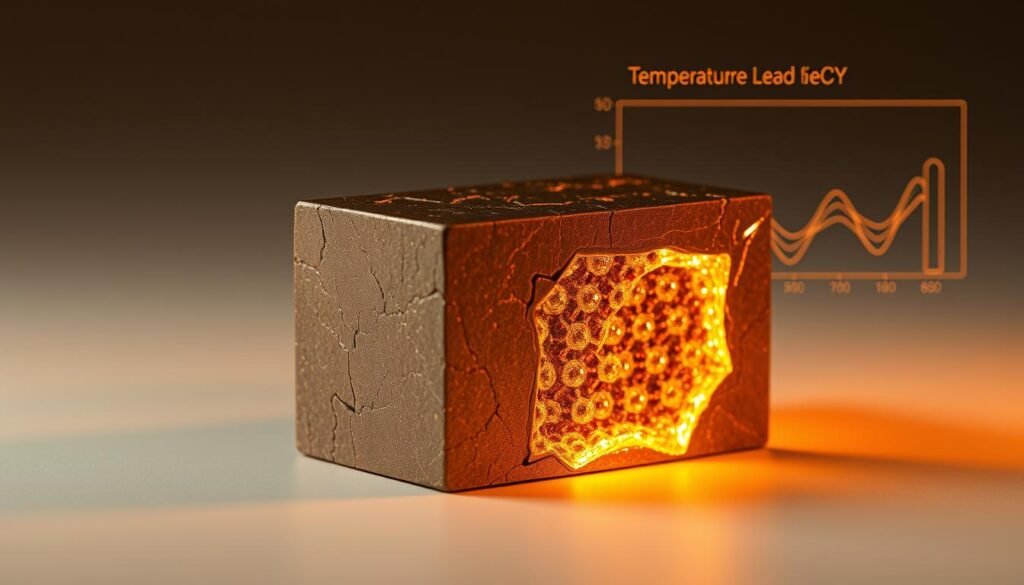
The table shows lead’s density drops with rising temperatures, near its melting point. This is a big deal in making things and using lead, where keeping size and density steady is vital for safety and workability.
Practical Applications of Lead’s High Density
Lead’s high density makes it useful in many industries. In radiation protection, lead is key in making barriers and shields. Medical places use lead aprons to keep patients and staff safe from harmful radiation during scans.
This safety measure improves health care quality. Lead’s density is also vital in energy storage, like in lead-acid batteries. These batteries are essential for cars, providing the power needed to start the engine.
Lead’s density helps in storing energy efficiently. This makes lead-acid batteries a top choice for vehicles.
Lead also helps in reducing noise pollution. In building and manufacturing, lead barriers are used to control noise. This is very helpful in cities where noise control is important for homes and businesses.
Looking at how lead’s density is used, we see its importance. It plays a big role in technology and safety. Lead’s unique properties make it valuable in many areas.
Understanding Safety Concerns When Working with Lead
Lead is known for its high density but poses serious health risks. Workers and companies must tackle lead safety concerns to safeguard employees and the environment. Exposure to lead can lead to neurological damage and developmental issues in children. This highlights the need for safe practices when handling lead materials.
Here are some best practices to reduce these dangers:
- Personal Protective Equipment (PPE): Wear gloves, masks, and goggles to lower lead exposure.
- Ventilation Measures: Make sure areas where lead is handled have good air flow to cut down airborne lead.
- Training and Awareness: Teach workers about lead’s dangers and how to handle it safely.
- Proper Waste Disposal: Follow local rules for disposing of lead materials to avoid harming the environment.
By focusing on lead safety concerns, industries can create safer workspaces. This not only protects employees but also the communities around industrial sites.
Conclusion
This article has explored lead density in detail. It shows lead’s unique traits and high density values. Lead’s standard density is about 11.34 g/cm³. It’s vital for its weight and many uses in construction, medicine, and shielding against radiation.
Lead’s atomic structure is key to its density. Its heavy, tightly packed atoms make it useful in engineering. Yet, we must also consider lead’s toxicity. By using it wisely and improving safety, we can enjoy its benefits while protecting our health.
Understanding lead density is important for its role in today’s technology. It helps us use lead safely and effectively. This balance will keep lead useful for years to come.