
Acrylonitrile Butadiene Styrene, or ABS, is a well-known thermoplastic polymer. It’s valued for its strong properties and wide use. This article focuses on ABS material density, a key factor in many industries.
Understanding ABS density helps engineers and manufacturers. It’s important for making decisions when working with ABS. We’ll also look at ABS’s composition, benefits, drawbacks, and uses in the market.
Introduction to ABS Plastic
ABS plastic is known for its strong qualities. It’s a key player in many manufacturing fields. The introduction to ABS plastic shows why it’s a top pick for engineers and designers. It’s great because it can handle impacts well and works well in different settings.
The benefits of ABS are many. It’s a go-to material in car, electronics, and consumer goods industries. Its toughness and flexibility help make products that last and look good. Plus, ABS is easy to work with, making production faster and more efficient.
ABS is used in more than just everyday items. In cars, it’s used for dashboards and bumpers, adding safety and style. For electronics, it’s in device casings, protecting and adding design flair. It’s also in household items and toys, proving its reliability across many sectors.
What is ABS Material?
Acrylonitrile Butadiene Styrene (ABS) is a common thermoplastic known for its strength and versatility. It’s made from acrylonitrile, butadiene, and styrene. These parts mix to create a polymer with special properties.
ABS is famous for being tough and able to withstand impacts well. This makes it durable in tough situations.
ABS is popular in many fields because of its strong properties. It can handle a lot of stress and stays stable in different conditions. It’s also easy to work with, thanks to its adaptability.
Techniques like injection molding and 3D printing make ABS a top choice for making products.
In short, ABS is a standout thermoplastic because of its special mix and reliable features.
Composition of Acrylonitrile Butadiene Styrene
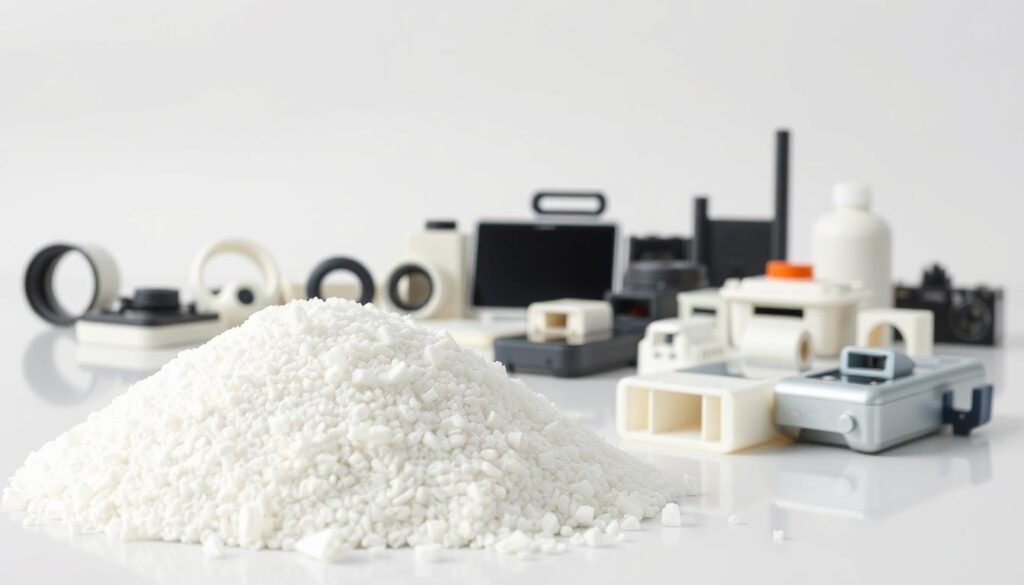
The composition of ABS is made up of three main parts: acrylonitrile, butadiene, and styrene. Each part adds something special to the material. Acrylonitrile, which makes up 15% to 35%, helps with chemical and heat resistance.
Butadiene, about 5% to 30%, gives ABS its toughness and ability to handle impacts. Styrene, making up 40% to 60%, adds rigidity and helps it resist heat. This makes acrylonitrile butadiene styrene great for many uses.
The exact mix of these parts can change based on what it’s used for. This flexibility makes ABS useful in many fields, from cars to everyday items. It’s all about meeting specific needs.
| Monomer | Percentage (%) | Function |
|---|---|---|
| Acrylonitrile | 15% – 35% | Enhances chemical resistance and thermal stability |
| Butadiene | 5% – 30% | Provides toughness and impact resistance |
| Styrene | 40% – 60% | Imparts rigidity and thermal resistance |
Want to learn more? Check out the Acrylonitrile Butadiene Styrene page for more info on this versatile material.
Understanding ABS Material Density
ABS material density is key to understanding its use and performance. Its density is usually between 1.04 and 1.06 g/cm³. Knowing about density is vital for engineers and makers. It affects the material’s strength and weight.
Definition and Importance of Density
Density is the mass per volume of a material. It’s a basic property that impacts how a material performs. For ABS, knowing this helps predict its behavior under different situations. A higher density means ABS can be stronger and more durable, which is important for tough applications.
Comparative Density of ABS with Other Plastics
It’s important to compare ABS density with other plastics to choose the right material. The table below shows the density of several plastics, including ABS:
| Material | Density (g/cm³) |
|---|---|
| ABS | 1.04 – 1.06 |
| Polycarbonate | 1.20 – 1.22 |
| Polystyrene | 1.05 – 1.07 |
| Polyethylene | 0.91 – 0.94 |
| Polypropylene | 0.90 – 0.91 |
ABS has a balanced density that works well for many uses. This makes it a flexible choice in the world of plastics. Designers can use this knowledge to pick ABS for their projects.

Properties of ABS Plastic
ABS plastic is widely used because of its great properties. It’s known for being tough and able to handle impacts well. This makes it perfect for places where things get rough.
Impact Resistance and Toughness
ABS plastic is amazing at handling impacts. It can take a lot of shocks without breaking. This is key for products that need to stay strong under stress.
Chemical and Thermal Resistance
ABS plastic also does well against chemicals. It can handle acids and alkalis, making it great for cars and gadgets. Plus, it stays stable in different temperatures. This makes ABS a top pick for things that need to last a long time.
| Property | Value |
|---|---|
| Density Range | 0.775 – 1.28 g/cc |
| Density (English Units) | 0.0280 – 0.0462 lb/in³ |
| Impact Resistance | High |
| Chemical Resistance | Good against acids and alkalis |
| Thermal Stability | Broad temperature range |
Applications of ABS Plastic
Acrylonitrile Butadiene Styrene (ABS) is used in many ways because it’s light and strong. It’s found in car parts like dashboards and body panels. This is because ABS can handle impacts well, keeping cars safe.
In the world of gadgets, ABS is used for phone and laptop casings. It looks good and works well, making it a favorite among makers. ABS also helps in 3D printing, making quick and custom designs possible.
ABS is also used in plumbing pipes for its strength and durability. It can handle chemicals well, making it a top pick for engineers and builders. ABS plays a big role in making and designing products today.
Advantages and Disadvantages of ABS
Acrylonitrile Butadiene Styrene (ABS) plastic is widely used because of its many benefits. It has high impact resistance, making it strong and durable. This is why it’s often found in car parts and gadgets.
ABS is also light, which helps save on shipping costs and makes it easier to handle. It can handle high temperatures well, making it reliable in tough environments.
But, ABS has its downsides. It can’t handle as much heat as some plastics, which might limit its use in very hot places. It’s also not good for the environment because it’s not biodegradable and can add to plastic waste. Without special protection, ABS can break down when it gets sunlight.
Knowing the pros and cons of ABS helps makers choose the right material for their needs. This ensures their products work well and last long in their intended use.
Manufacturing Process of ABS Plastic
The ABS manufacturing process uses injection molding and extrusion. These methods turn raw materials into finished products. They keep the products’ quality and performance high.
Injection molding heats raw materials and shapes them in molds. It’s great for making complex parts with precision. This method is fast and efficient for making lots of items, like car parts and gadgets.
Extrusion makes sheets and pipes by flowing materials through a die. It creates long shapes that can be cut to any length. This method saves material and makes products uniform.
Adding stabilizers and fillers to ABS improves its performance. These additives help with UV resistance, heat tolerance, and durability. They ensure the products meet tough industry standards.
Conclusion
ABS plastic is a key thermoplastic material known for its unique properties. It meets the needs of many industries. Its impact resistance, chemical stability, and thermal resilience make it a top choice for engineers and designers.
This article has covered ABS properties in detail. It highlights its strengths and some possible limitations. ABS is used in many fields, from cars to electronics. It allows for creative designs while keeping products durable.
As industries evolve, knowing ABS well is essential. It helps in making new products better. ABS plastic’s abilities make it a strong player in the market.
Understanding ABS’s material density and characteristics is important. It helps professionals use ABS to its fullest. This ensures ABS remains a key part of future innovations.