
Exploring 7075 aluminum density reveals important details about a key aluminum alloy. It’s known for its high strength and resistance to corrosion. This makes it vital in industries like aerospace and automotive.
Knowing the specific gravity and chemical makeup of 7075 aluminum is critical. It helps determine if the alloy is right for tough tasks. In this article, we’ll dive into the details of 7075 aluminum density. We’ll see why it’s so important in many fields.
Introduction to 7075 Aluminum Alloy
The 7075 aluminum alloy is a top choice in aerospace materials. It’s known for its high strength and light weight. This comes from zinc, its main alloying element. It’s also known for its strong mechanical properties and durability.
This alloy was first made in the 1930s. It was created for military and civilian planes. Now, it’s used in many fields where strength and lightness matter.
7075 is a favorite among engineers and makers. It’s chosen for its top-notch performance in tough settings. Its mix of aerospace materials and high-strength alloys makes it stand out.
Understanding 7075 Aluminum Density
Knowing the density of materials is key for engineers and designers. It’s vital in picking the right materials for different uses. Density is the mass per unit volume, a critical property that impacts how materials perform.
In engineering, density affects a material’s weight, strength, and how well it holds up. This guides the choice of alloys for both performance and safety.
Definition of Density in Materials
The density of alloys like 7075 aluminum is about 2.81 g/cm³. This density is important for uses that need both strength and lightness. Understanding density helps see how materials act under stress and how to use them best in building things.
So, checking a material’s density is key before deciding on what to use for making things.
Importance of Density in Aerospace Applications
In the aerospace world, aluminum density is very important. Aircraft need to be strong but also light to save fuel and improve performance. 7075 aluminum is a top pick because it’s light yet strong.
When engineers look at options, they focus on how much weight a material can hold. This makes the density of 7075 aluminum a big deal in choosing materials.
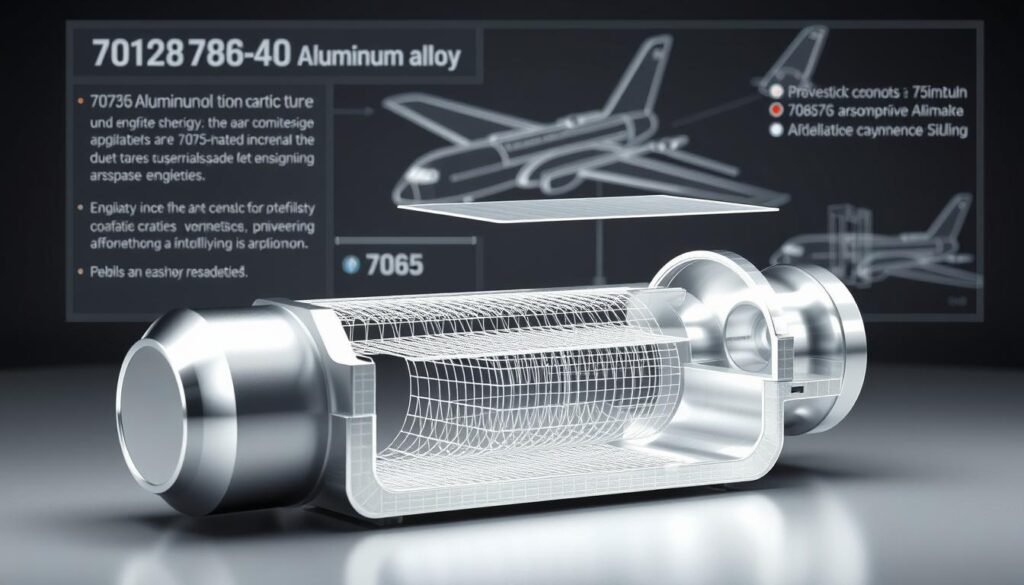
Chemical Composition of 7075 Aluminum
Knowing what makes up 7075 aluminum helps us see why it’s so strong and light. It’s perfect for tough jobs because of its high strength-to-weight ratio. The 7075 aluminum composition has special elements that make it stand out.
Key Alloying Elements
The main alloying elements in 7075 aluminum are key to its success. These include:
- Zinc (5.1-6.1%)
- Magnesium (2.1-2.9%)
- Copper (1.2-2.0%)
- Chromium (0.18-0.28%)
- Silicon (up to 0.40%)
Together, these elements boost the alloy’s corrosion resistance, strength, and how well it can be machined.
Typical Chemical Composition Values
Looking at the typical values of 7075 aluminum gives us a clearer picture:
| Element | Typical Range (%) |
|---|---|
| Zinc | 5.6-6.1 |
| Magnesium | 2.1-2.5 |
| Copper | 1.2-1.6 |
| Silicon | up to 0.40 |
| Iron | up to 0.5 |
| Manganese | up to 0.3 |
| Titanium | up to 0.2 |
| Chromium | 0.18-0.28 |
The exact mix of elements in 7075 aluminum composition makes it great for aerospace and industrial uses. Knowing how each alloying element works shows why exact measurements are so important for the right aluminum alloy characteristics.
Physical Properties of 7075 Aluminum
The physical properties of 7075 aluminum are key to understanding its performance. It’s known for its strength and durability. This makes it great for uses where materials need to be both light and strong.
Density and Weight Specifications
The density of 7075 aluminum is about 2.81 g/cm³. This density helps it have a good strength-to-weight ratio. It’s perfect for high-stress environments because of this.
The weight of 7075 aluminum is also noteworthy. It’s light, which is great for aerospace and military uses. Here’s a table showing its specifications.
| Property | Value |
|---|---|
| Density | 2.81 g/cm³ |
| Weight (per cubic meter) | 2810 kg/m³ |
Thermal and Electrical Conductivity
7075 aluminum also has great thermal properties. Its thermal conductivity is between 130-150 W/m*K. This means it can efficiently cool down, which is important for high-performance uses.
The electrical properties of 7075 aluminum are also noteworthy. It has low electrical resistivity. This makes it good for electrically conductive uses.

Mechanical Properties of 7075 Aluminum
The mechanical properties of 7075 aluminum are key in many fields, like aerospace and automotive. It’s known for its high tensile strength of 572 MPa (83.0 ksi) in T6 temper. The yield strength is about 503 MPa (73 ksi), making it a top pick for tough jobs.
Tensile Strength and Yield Strength
The tensile strength shows how much stress a material can handle before breaking. For 7075 aluminum in T6 temper, it’s perfect for high-stress tasks. The yield strength is the point where the material starts to bend without going back to its original shape. This makes 7075 aluminum reliable in aerospace and automotive fields.
Impact of Tempering on Mechanical Properties
Tempering greatly changes the mechanical properties of aluminum alloys like 7075. T6 and T651 tempering improve strength and reduce stress corrosion. The right tempering ensures the alloy performs well under different loads, meeting strict standards.
| Property | T6 Temper | T651 Temper |
|---|---|---|
| Tensile Strength (MPa) | 572 | 570 |
| Yield Strength (MPa) | 503 | 400 |
| Elongation (% at break) | 11 | 14 |
Comparison of 7075 Aluminum to Other Aluminum Alloys
Aluminum alloys vary greatly in their properties and uses. 6061 vs 7075 aluminum are notable for their unique traits. 7075 is prized for its high strength, ideal for aerospace needs. On the other hand, 6061 is versatile for everyday projects.
Differences Between 7075 and 6061 Aluminum
Understanding the main differences between 7075 and 6061 is key. 7075 has a higher tensile strength but is less resistant to corrosion than 6061. 6061 is easier to work with and used in more projects.
Comparative Strength and Density Values
The strength and density of 7075 and 6061 differ significantly. 6061 has a density of about 2.70 g/cm³, lower than 7075. Yet, 6061 can’t match 7075’s tensile strength. This makes 7075 better for high-stress situations.
Applications of 7075 Aluminum
7075 aluminum is a top pick in many fields, like aerospace and defense. It’s light but strong, perfect for high-stakes jobs. This makes it safe and effective in critical areas.
Use in Aerospace and Defense Industries
In aerospace, 7075 aluminum is key for making planes and spaceships. It’s used for parts like aircraft structures and missile components. For example, it’s in Space Shuttle SRB nozzles and external tank SRB beams.
In defense, it’s used for military parts, like M16 and AR-15 rifle components. This shows its strength and reliability.
Applications in Automotive and Sports Equipment
In cars and bikes, 7075 aluminum is a big deal. It’s used in racing frames and motorcycle parts because of its strength and lightness. It’s also in sports gear, like bikes and climbing equipment, for its toughness and lightness.
| Sector | Applications |
|---|---|
| Aerospace | Aircraft structural parts, missile systems, aerospace fittings |
| Defense | Military applications, firearms parts |
| Automotive | Racing frames, motorcycle parts |
| Sports Equipment | Bicycles, rock climbing gear, inline-skating frames |
Heat Treatment and Forming Processes for 7075 Aluminum
Heat treatment is key to improving aluminum alloys. For 7075 aluminum, special processes boost its strength. The T6 tempering, which includes solution heat treating and aging, refines its structure.
Common Heat Treatment Processes
7075 aluminum undergoes several heat treatment steps:
- Solution Heat Treatment (SHT): Heats the alloy to dissolve certain phases.
- Quenching: Quickly cools the alloy to keep elements dissolved.
- Aging: Reheats the alloy to improve strength and hardness.
These steps are vital for 7075’s unique properties. They prepare it for high-stress uses.
Impact on Mechanical Properties and Density
Heat treatment greatly affects aluminum. The T6 treatment on 7075 aluminum changes its properties. For instance, tensile strength can hit 618.3 MPa at 500°C SHT.
Hardness also increases, reaching 171 VHN at the same temperature. This shows how heat treatment can alter mechanical properties.
The density of 7075 aluminum stays around 2.7 g/cm³. Heat treatment can improve tensile strength while keeping specific strength ratio good. For more on this, check out this study on heat treatment of aluminum.
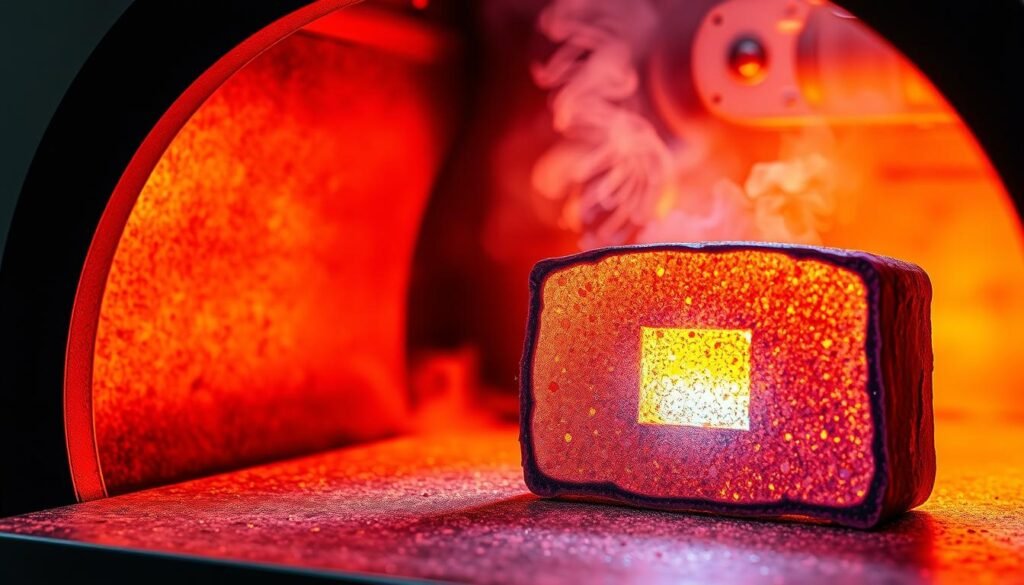
Knowing how these treatments work helps manufacturers use 7075 aluminum well. They can enhance its properties through careful heat treatment and forming.
Benefits and Drawbacks of Using 7075 Aluminum
7075 aluminum is a top choice for tough environments because of its strong properties. It’s favored in fields like aerospace and cars for its strength. Knowing its good and bad points helps makers and engineers choose wisely.
Advantages in High-Stress Applications
The advantages of 7075 aluminum include its high strength and low weight. It’s great for parts that face a lot of stress. It also can be shaped well, making complex designs easier.
Here are some examples of 7075 aluminum in use:
- Aerospace parts like fuselages and wings.
- Military gear, like rifles, for their strength and lightness.
- Top-notch sports items, like bikes and climbing gear.
Challenges and Limitations of 7075 Aluminum
But, 7075 aluminum has its downsides. It can crack under stress, which is a big problem in harsh places. It’s also harder to shape than some other metals, like 6061. Knowing these limitations of 7075 aluminum alloy is key when designing.
For more on using this alloy in different fields, check out this resource. Knowing both the good and bad helps use 7075 aluminum to its fullest while avoiding risks.
Future Trends in 7075 Aluminum Usage
The world of 7075 aluminum alloy is changing fast. New research is making it stronger and more resistant to corrosion. This is key for using it in more places.
Experts are working hard to make the alloy better. They want it to meet the needs of today’s technology. This means making it stronger and more durable.
Innovations in Alloy Development
New developments in 7075 aluminum focus on its strength and versatility. They aim to make it even better for the future. This could include using new ways to make the alloy.
These improvements will help the alloy handle tough conditions. It will stay light and strong, perfect for many uses.
Emerging Applications in Modern Engineering
7075 aluminum is going to be used in new areas like robotics and big civil projects. Its strength and lightness make it ideal for these tasks. It helps create better structures and designs.
This fits with the trend of using new technologies in aluminum. It shows how the alloy is becoming more important in engineering.
Conclusion
7075 aluminum is a key material in many fields, like aerospace and defense. It’s known for being strong yet light. This makes it perfect for places where weight matters but strength is key.
Understanding its makeup and how it works helps engineers use it well. Its high strength and low weight are big pluses. They’re important for projects that need to perform well but can’t be too heavy.
Aluminum alloys, like 7075, are more than just strong. They’re also getting better with new tech. As we move forward, 7075 aluminum will keep getting better. This is great for meeting today’s engineering needs.